Article: nitorito: Knit and Weave — Stoles Made in Snowy Yonezawa

nitorito: Knit and Weave — Stoles Made in Snowy Yonezawa
In Yonezawa, Yamagata — a snowy town in northern Japan known for its traditional Yonezawa-ori weaving — we visited Aobun Textile, the mill behind nitorito. To share the beauty of knitting and weaving, and the charm of Yonezawa itself, the mill created nitorito, a brand of stoles and other textiles that today operates as its own company.

Knit and weave
What makes Aobun Textile special is that a knitting business, using circular knitting machines, and a weaving business exist side by side in one company — something said to be rare even worldwide. Yonezawa is famous for its woven textiles, and in a town buried in snow every winter, soft, warm knits are also much loved. Perhaps that background is what gave rise to a mill that does both.

"Knit and weave" in Japanese is nitto to ori to — and so the brand was named nitorito. Its logo traces the flowing lines of Yonezawa's mountains, and most nitorito products use knitting and weaving in some form.
The difference between knitting and weaving
Weaving interlaces vertical warp threads and horizontal weft threads. On a loom, a shuttle travels back and forth, passing the weft between the warp threads. Because the threads simply cross, woven fabric is flat, with little stretch and limited breathability.

Knitting, on the other hand, makes a loop, then another loop through it, again and again. That is why knits stretch, breathe well and feel soft and airy. The two are completely different structures, made in completely different ways.

What is circular knitting?
Among knitting methods, circular knitting is nitorito's speciality and strength. Row upon row of large, complex circular knitting machines fill the mill.

Their structure is highly complex, and every machine is set up entirely by hand. A skilled craftsman spends many hours setting up a single machine.

Before that, yarn must be wound onto special cones; before that, prepared for winding; and before that, dyed. So many unseen steps go into making a fabric that the number of meters a machine can knit in a day says very little on its own.

There are two kinds of knitting machine. Flat knitting machines work back and forth and can shape a piece as they knit, with little waste. Circular knitting machines knit in a spiral, producing a seamless tube — fabric that must later be cut and sewn into shape, sometimes with waste. Seamless T-shirts are often made this way. Aobun Textile is highly skilled in circular knitting, and high-end fashion brands come all the way to Yonezawa for its technique and flexibility.

Hidden behind the big brands
Even when a mill's weaving and knitting expertise is well known in the industry, consumers never hear its name. However skilled you are, selling fabric alone means you never hear from the people who use it. Aobun Textile has more than 140 years of history in Yonezawa, but as the region's craftspeople age, Mr. Suzuki — a director of Aobun Textile and nitorito's brand manager — began to worry that the whole textile region could be at risk.

The mill's own staff seemed young, but the region as a whole was far from secure. Selling fabric to apparel brands, however proudly, would never make the name of Yonezawa — a region of skill and history — known, nor keep its techniques alive. From that wish, nitorito was born: a brand to share the craft of Yonezawa and Aobun Textile.
Turning a weakness into a strength
A circular knitting machine knits a tube and cannot shape the fabric. If you cut it to change its shape, it frays from the cut edge, so the edges must be overlocked. Compared with flat knitting, shaping takes more work and wastes fabric — it simply can't compete.

Looking for a solution, Mr. Suzuki drew on the know-how gained through years of manufacturing for other brands. The idea: knit with wool, then mill the fabric so that it felts. Wool fibers bind together when wet and agitated. By deliberately milling (felting) the fabric after knitting, the fibers lock together so the fabric won't fray when cut, unless pulled hard.

This is a stole before milling — it is very large, showing just how much it shrinks. After milling, it becomes a standard-size stole of about 85 × 180 cm.

The felted tube can be cut anywhere without fraying, and cutting it completes the stole. Wool is already an excellent material — warm, water-repellent, odor-resistant and moisture-regulating. Milling turns those qualities into strengths of the product, and turns the extra work of cutting and shaping into something unique: a high-performance stole you could even cut to your liking. Getting the degree of felting right is crucial and difficult — not too stiff, still soft with the feel of wool, yet never fraying when cut.

Made in Yonezawa
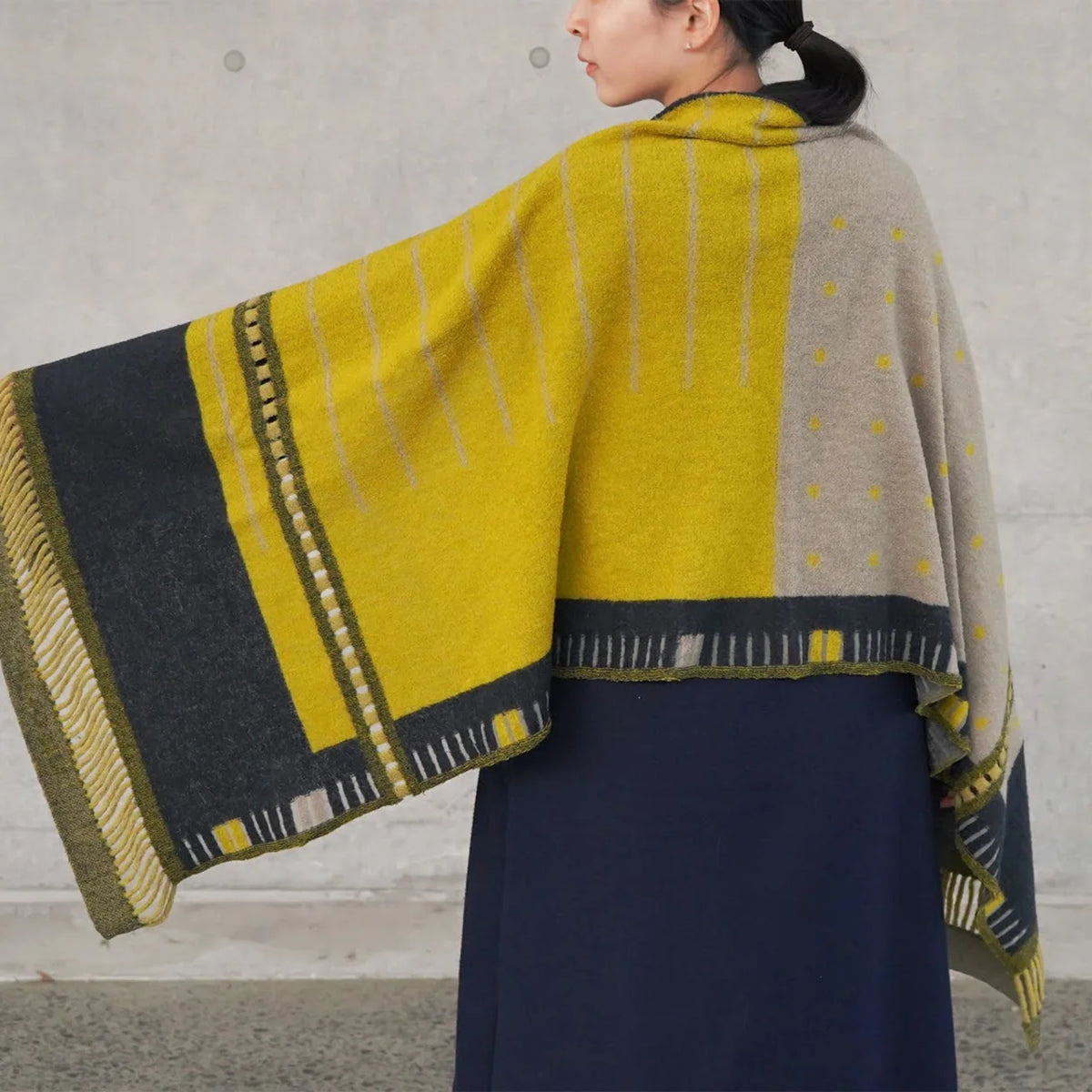
Every nitorito stole is inspired by Yonezawa's landscapes and rich nature. hamura depicts clusters of leaves in Yonezawa's lush nature; the random contrasts of the leaves are turned into a geometric pattern spread across the stole like sashiko stitching.

wadachi ("ruts") reflects life in this heavy-snow region: footprints are made in the snowy road, snow falls again, and new footprints appear. These layers of snow-country life are expressed in gradated blocks, with a single line running through like a rut. True to its "made in Yonezawa" spirit, nitorito uses only fibers of natural origin, such as wool and cotton.

No future without a challenge
Listening to Mr. Suzuki, we felt his strong love for Yonezawa. Taking on something new within a long-established company is surely not easy, but his challenge — for the region and the company's future — is bound to ripple through the whole area. Moved by Aobun Textile and his efforts, a designer, Ms. Saito, moved all the way from Tokyo to Yonezawa and now leads nitorito's design — having visited weaving mills across Japan in person before choosing this one, much to Mr. Suzuki's surprise.

Many regional makers struggle to find successors. Ms. Saito's search for the ideal place to make things is admirable — and it shows that young people will seek out companies and makers taking on inspiring challenges. The ruts made by a new challenge become a guide for those who follow. nitorito has begun to leave its tracks in Yonezawa.
Watch how it is made
Our sincere thanks to Mr. Suzuki and Ms. Saito for their time and for kindly showing us around the mill.